
Editor’s note: This article provides general preparedness information, not electrical or medical advice. Have a licensed electrician handle any connection to household wiring. For medical equipment, confirm backup-power compatibility with the equipment manufacturer and your healthcare team.
When you live on a houseboat, in a converted church bus, or off-grid, electricity stops being something you take for granted. You make, store, and ration it. You quickly learn what you actually need power for, and what you only thought you did.
That experience changes how you hear the word “EMP.” Most online conversation is either panic or eye-rolling. The useful middle ground is simpler: understand what can damage electronics, consider which threats are realistic where you live, and spend your money in the right order.
This article walks through that approach, including an honest look at whether a product like the Grid Doctor 3300 belongs in your plan.
Start With the Outage You’re Most Likely to Face
Before we talk about solar storms and nuclear pulses, look at what actually turns the lights off. According to the U.S. Energy Information Administration, the average U.S. electricity customer experienced roughly 11 hours of interruptions in 2024, with major events accounting for about 80% of that time. Those figures are national averages; your experience will depend heavily on local weather and infrastructure. Source: U.S. Energy Information Administration.
Here in East Tennessee, Hurricane Helene was a hard reminder that a weather-related outage can last days, not hours.
That’s the baseline. Any power-protection plan that doesn’t handle an ordinary multi-day outage first is built upside down.
EMP, Solar Storms, Lightning, and Outages Aren’t the Same Thing
People lump these together, but they affect equipment in different ways and call for different precautions.
- Ordinary outage: Utility power stops. Your immediate challenge is keeping essentials running: refrigeration, well pumps, communications, medical devices, and heating or cooling where practical. The interruption itself doesn’t necessarily damage appliances, although voltage disturbances or restoration surges can accompany some outages.
- Lightning and electrical surges: Sudden voltage spikes can enter through power or communications wiring and damage connected equipment. Proper grounding, surge-protective devices, and professional installation help reduce risk; they do not make a home lightning-proof.
- Solar (geomagnetic) storms: Disturbances in Earth’s magnetic field can induce currents in long conductors, especially transmission lines. The greatest concern is disruption to grid infrastructure, potentially producing widespread outages. A severe storm disrupted Quebec’s electric grid in 1989. The major May 2024 geomagnetic storm showed why grid monitoring and preparation matter.
- High-altitude nuclear EMP: Engineers describe several components, commonly called E1, E2, and E3. E1 is a very fast electromagnetic pulse that can couple into susceptible electronics and wiring; E2 has some similarities to lightning-related transients; E3 is slower and can affect long conductors and the grid. Actual damage depends on exposure, shielding, wiring, and equipment design.
The key distinction: A solar storm does not produce the same fast E1 component associated with a high-altitude nuclear EMP. For most households, preparing for an extended power outage is more immediately useful than buying equipment based solely on an EMP claim.
What’s Actually at Risk in Your Home?
- The grid: Major geomagnetic disturbances and E3 effects can affect transmission infrastructure. You can’t personally shield the regional grid, but you can plan for interruptions.
- Equipment connected to wiring: Appliances, computers, routers, and controls may be exposed to surges or disturbances conducted along power and communications cables.
- Sensitive electronics, even when unplugged: Under some EMP scenarios, electromagnetic energy can couple directly into susceptible equipment. The level of risk is highly situation-dependent; unplugging is not a universal guarantee of protection.
- Communications and essential devices: A working weather radio, spare batteries, chargers, and a way to receive local updates are valuable during many kinds of emergencies.
So “protect my electronics” really means three different jobs: reduce surge risk, maintain backup power, and consider shielded storage for a few critical spares.
What Is the Grid Doctor 3300?
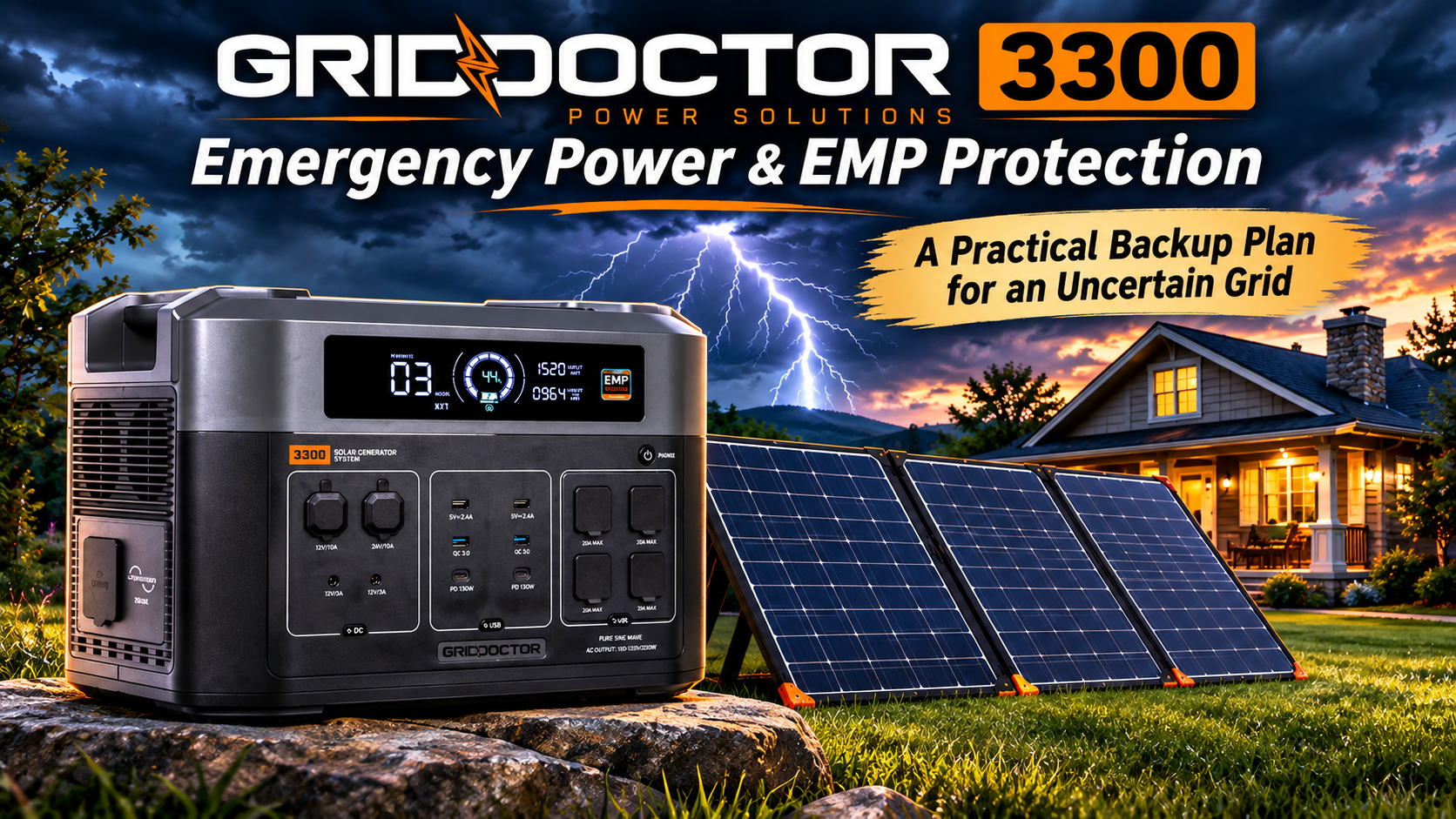
The Grid Doctor 3300 is a battery-powered portable power station marketed by My Patriot Supply. Although often called a “solar generator,” it doesn’t create electricity on its own: it stores energy supplied by a wall outlet, compatible solar panels, or other supported charging sources. Unlike a gasoline generator, it produces no engine exhaust and can generally be operated indoors according to its instructions, with appropriate ventilation and clearance.
The manufacturer’s advertised features include:
- 2,048 watt-hours (Wh) of battery capacity and a 3,300-watt AC inverter. Capacity tells you roughly how much energy is stored; inverter wattage tells you how much load it can supply at once.
- Lithium iron phosphate (LiFePO4) battery chemistry, widely used in rechargeable backup-power equipment.
- UPS-style switchover, intended to keep certain connected devices powered when incoming electricity fails. Check the published transfer time and your device’s requirements rather than assuming uninterrupted operation for every device.
- Pass-through charging and charging options that may include solar, wall power, and vehicle input, subject to the manufacturer’s connection and input limits.
- Expansion options, depending on compatible accessories and the bundle purchased.
- “EMP Intercept Technology,” which the seller markets as a protective feature. The scope and independent verification of that protection deserve closer examination, discussed below.
Before you buy: Confirm the current specifications, warranty, return terms, weight, charging-input limits, included panels, and expansion accessories on the seller’s actual listing. Bundles and promotional pricing can change.
Affiliate disclosure: Some links in this article are affiliate links. If you buy through them, PrepperMethod may earn a commission at no additional cost to you. That does not change our assessment.
See the current Grid Doctor 3300 package and price: Check the manufacturer’s current offer.
How Long Will a 2,048Wh Battery Actually Run Your Equipment?
This is the question I would ask before worrying about EMP protection.
A 3,300W inverter does not mean you can draw 3,300 watts for hours. The battery stores 2,048Wh, and some energy is lost when the inverter converts battery power into household AC power. For a rough illustration, assume about 85% of the rated battery energy reaches AC devices, or approximately 1,740Wh. These are planning examples, not independently measured Grid Doctor runtimes.
| Average continuous load | Illustrative runtime |
|---|---|
| 50W | About 35 hours |
| 100W | About 17 hours |
| 200W | About 8.5 hours |
| 500W | About 3.5 hours |
| 1,000W | About 1.7 hours |
Real results vary with load, battery condition, temperature, conversion losses, and other factors. Refrigerators and freezers cycle on and off, so their average energy use is often more useful than their running wattage alone. Motors and compressors can also require a much higher startup surge than their normal operating draw.
The practical lesson: list the equipment you need, measure or estimate its daily energy consumption, and check both its running watts and starting watts against the power station’s specifications.
What About Solar Recharging?
Solar panels can extend usefulness during a prolonged outage, but “200W panel” means a rated output under test conditions, not 200 watts every hour of daylight. Shade, clouds, season, panel angle, temperature, and charging losses all affect production.
As a simple illustration, replenishing 2,048Wh with a panel actually producing a steady 200W would take more than ten hours before charging losses. Real-world recharging may take substantially longer. Additional compatible panels may help, but only within the unit’s specified solar-input limits.
Check how many panels are included in the package you’re considering. Don’t assume that a photo of several panels means they all come in the box.
Installation and Safety
For ordinary portable use, plug compatible devices into the power station’s outlets as directed by its manual. Connecting any portable power source to household circuits requires suitable transfer equipment and a licensed electrician. Never backfeed a household wall outlet. Doing so can endanger utility workers and create serious fire or electrocution hazards.
For CPAP machines, oxygen concentrators, or other medical equipment, verify power draw, startup requirements, waveform compatibility, switchover tolerance, and expected runtime with the equipment manufacturer and your healthcare team. A marketing claim about UPS functionality is not proof of medical-device compatibility. Don’t depend on an untested arrangement for life-sustaining equipment.
Does the EMP Protection Work? What We Can and Can’t Verify
This is where we need to be straight with you.
What the product specifications support: The Grid Doctor 3300 is marketed as a substantial battery backup system with a high-output inverter, rechargeable LiFePO4 storage, and UPS-style functionality. Those features can be useful for ordinary outages whether or not a nuclear EMP ever occurs. We have not independently bench-tested this unit, so specifications should not be mistaken for our own performance findings.
What the seller claims: My Patriot Supply promotes “EMP Intercept Technology” and has described rapid protection-circuit response, including a claim involving a three-nanosecond response and independent testing. That is a seller-reported claim, not a test report we’ve independently reviewed.
What remains unverified in this review: We do not have a publicly reviewable independent report demonstrating that the complete Grid Doctor 3300 system, in specified operating and connection configurations, survived a standardized high-altitude nuclear EMP exposure. A circuit’s reported response time alone doesn’t establish whole-system survivability. If EMP hardening is central to your decision, ask the seller for the laboratory name, full test report, test conditions, applicable standard, and exactly which components and connections were tested.
Two other considerations matter:
- Protecting the power station doesn’t automatically protect everything attached to it. Cables and connected equipment can create separate exposure paths.
- Shielded storage can be a separate layer. A properly designed Faraday enclosure may reduce electromagnetic exposure to unplugged spares, but its effectiveness depends on construction, closure, seams, openings, and testing.
And remember: ordinary surge protectors are not a guaranteed defense against nuclear EMP. They are intended for specified electrical transient conditions, not every conceivable electromagnetic event.
What I Would Check Before Spending This Much
A big battery system deserves the same careful evaluation as any other major household purchase:
- What comes in the package? Confirm solar panels, charging cables, accessories, and whether expansion batteries cost extra.
- Will it run your actual essentials? Compare running watts, startup surges, and expected daily watt-hours—not just the inverter’s headline wattage.
- How quickly can you recharge it? Compare your likely solar production and available charging sources against daily consumption.
- What do warranty and returns actually cover? Read the current terms, including battery coverage, shipping, restocking charges, and any exclusions.
- How practical is it to move and store? Consider the unit’s weight, outlet layout, storage conditions, and where you’ll charge it.
- How strong is the EMP evidence? Request the complete independent test documentation if that claim affects your willingness to pay.
If the product fits your needs even without the EMP marketing claim, you’re evaluating it on much firmer ground.
Compare the current Grid Doctor 3300 bundle with your checklist: View the seller’s current offer.
Other Measures That Matter, Often More
1. Whole-Home Surge Protection
A properly selected and installed whole-home surge-protective device can reduce damage from some incoming electrical surges. The 2020 National Electrical Code introduced requirements for surge protection in certain residential service installations and replacements, but local adoption and the rules applicable to your home vary. Ask a licensed electrician what applies where you live.
Pair panel-level protection with suitable point-of-use devices where appropriate. Neither approach makes electronics immune to a direct lightning strike or every surge.
2. Backup Power Sized to Your Real Needs
Start with your refrigerator, freezer, well pump, essential communications, and any medical equipment. Add lighting and heating or cooling loads where practical. Then decide whether a smaller power station, a larger battery system, a properly installed fuel generator, or a combination makes the most sense.
3. Shielded Storage for a Few Spares
A purpose-built, appropriately tested Faraday bag or enclosure may be worth considering for a backup radio, charger, or other small electronics. A metal container can sometimes provide shielding, but a tight-looking lid is not proof of effective protection. Keep spare devices insulated from the enclosure’s metal surfaces and follow the enclosure manufacturer’s instructions.
For more practical grab-and-go essentials, see our bug out bag checklist.
4. Redundancy Over Any Single Device
No one product covers every threat. Depending on your needs and budget, two independent charging methods, spare batteries, a safe fuel-powered option, and non-electric basics may be more useful than one expensive device.
Stored drinking water, a manual can opener, flashlights, and a battery-powered weather radio are not exciting purchases. But during a real outage, they earn their keep.
Who Should Consider the Grid Doctor 3300?
It may be worth a closer look if you:
- Need a high-output, rechargeable backup power station for household essentials.
- Want a quieter, exhaust-free alternative to running a fuel generator indoors (fuel generators must never be operated indoors).
- Have checked your equipment’s running load, startup surge, and required runtime.
- Have realistic options for recharging during an extended outage.
- Treat EMP-related claims as a possible extra feature rather than the only reason to buy.
It probably isn’t your next purchase if you:
- Still need basic water, food, lighting, and communication supplies.
- Haven’t worked out how much energy your essential equipment actually uses.
- Expect a 2,048Wh battery to run an entire home for days without recharging.
- Are stretching your budget mainly because of frightening EMP advertising.
- Need assured compatibility with critical medical equipment but haven’t verified it.
Our Recommendation: What to Do First
Here’s the order I’d recommend to my own family:
- Prepare for a three-day outage with water, food, lighting, communications, and any necessary medications or medical contingency plans.
- Ask an electrician about surge protection and safe options for connecting backup power to household circuits.
- Size backup power to your actual essentials. A unit like the Grid Doctor 3300 could make sense if its capacity, output, charging options, and price match your needs.
- Consider shielded storage for a few critical spares, understanding that the quality of the enclosure matters.
- Test your plan. Run your intended essentials under safe, supervised conditions and learn your real runtime and recharge needs well before an emergency.
What remains uncertain: How a particular consumer power station would perform under a real-world nuclear EMP depends on exposure conditions, its design, and what is connected to it. Published, independent, relevant testing would be more persuasive than a broad “EMP-proof” label.
Preparedness isn’t about predicting the exact disaster. It’s about making sure that when the power goes out, for whatever reason, your family doesn’t skip a beat.



Leave a Reply